SGIteration_MaxMinMax Class Reference
Stores data on the behavior of SGSolver_MaxMinMax. More...
#include <sgiteration_maxminmax.hpp>
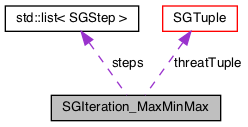
Collaboration diagram for SGIteration_MaxMinMax:
Public Member Functions | |
| SGIteration_MaxMinMax () | |
| Default constructor. | |
| SGIteration_MaxMinMax (const vector< list< SGAction_MaxMinMax > > &_actions, const SGTuple &_threatTuple) | |
| void | push_back (const SGStep &step) |
| Add an SGStep. | |
| const list< SGStep > & | getSteps () const |
| Get method for the steps. | |
| const vector< vector< SGBaseAction > > & | getActions () const |
| Get method for the actions available at the current iteration. | |
| const SGTuple & | getThreatTuple () const |
| Get method for the current threat tuple. | |
| template<class Archive > | |
| void | serialize (Archive &ar, const unsigned int version) |
| Serialize the iteration using Boost. | |
Private Attributes | |
| vector< vector< SGBaseAction > > | actions |
| SGTuple | threatTuple |
| list< SGStep > | steps |
Friends | |
| class | boost::serialization::access |
| Serializes the SGIteration_MaxMinMax object using boost. | |
Detailed Description
Stores data on the behavior of SGSolver_MaxMinMax.
This class records the status of the max-min-max algorithm after each implementation of the max-min-max operator.
Constructor & Destructor Documentation
◆ SGIteration_MaxMinMax()
|
inline |
Initializes a new SGIteration_MaxMinMax object with data on the current iteration
The constructor will copy the data in SGSolver_MaxMinMax::actions, so that the user can later recover the test directions that were available at each step. For large games, storing the actions can take a large amount of memory.
Member Data Documentation
◆ actions
|
private |
The actions that can be supported at the current iteration
◆ steps
|
private |
The steps in the iteration
◆ threatTuple
|
private |
The current threat tuple.
The documentation for this class was generated from the following file:
- src/hpp/sgiteration_maxminmax.hpp